
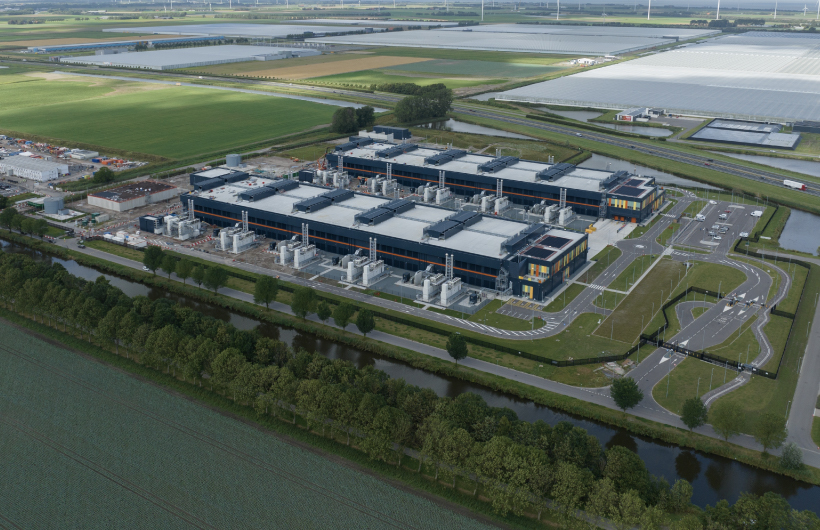
Why Cooling Towers Make Water Management a Data Center Priority
Modern data centers are, at their core, energy-to-heat conversion machines: nearly all electrical power feeding servers and supporting equipment ultimately becomes heat that must be removed and discharged to the environment. In many facilities, that heat is carried away by chilled-water or condenser-water systems and rejected outdoors via evaporative heat-rejection equipment, such as cooling towers. A cooling tower does not “make cool air” for the data hall; it cools a water stream (often condenser water) by evaporating a portion of it into an airstream, and the cooled water is collected in a basin and pumped back to repeat the cycle. Because data centers frequently run at high load around the clock, cooling tower water demand and operational exposure (evaporation, blowdown, drift, and leakage) can persist. As a result, large volumes of water must be continuously circulated, stored, and managed, often in large concrete basins located below grade.
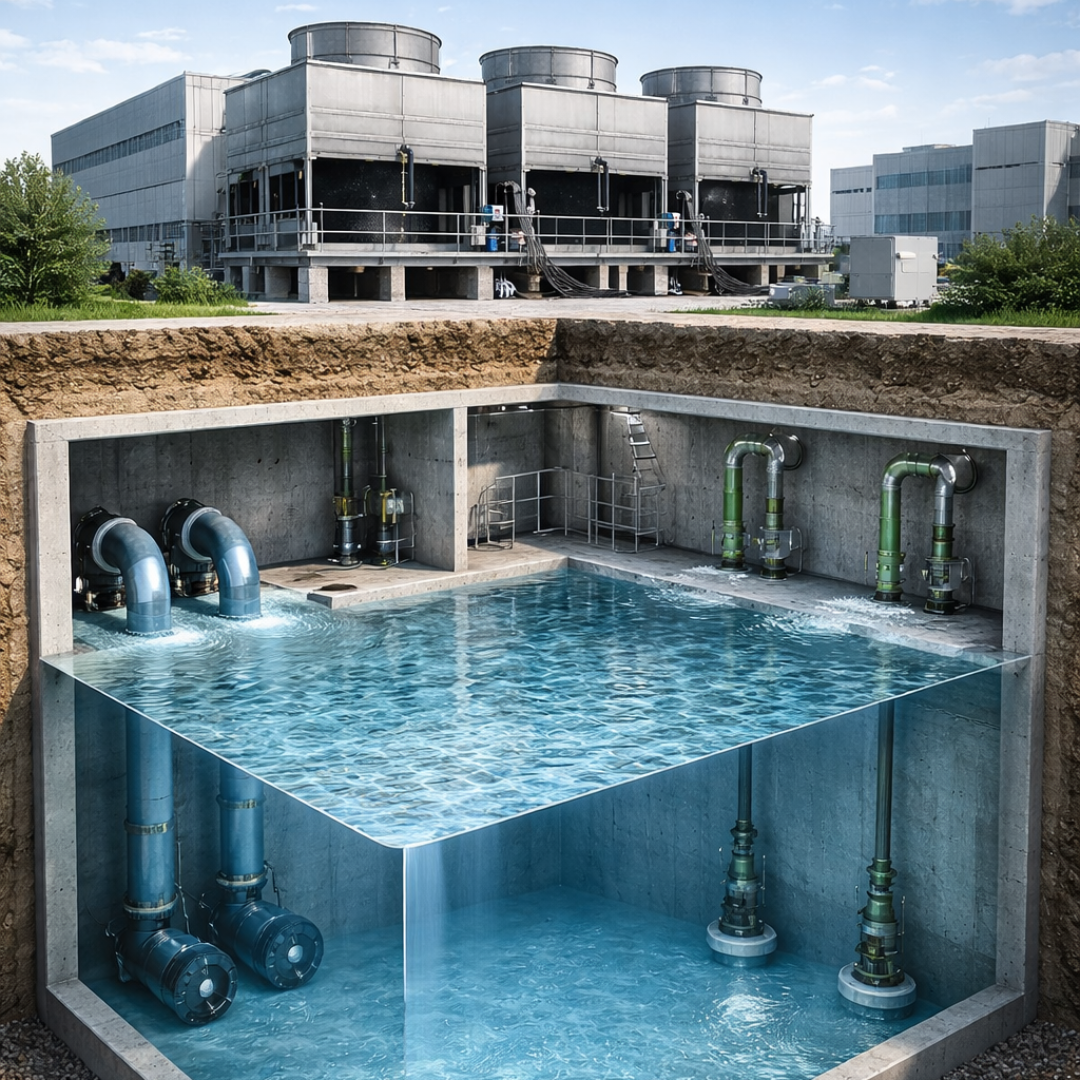
Why Below-Grade Concrete Basins Are Difficult to Keep Watertight
Cooling tower systems typically rely on large concrete basins that collect and recirculate cooled water.
Where cooling infrastructure relies on large in-ground or below-grade concrete basins (or adjacent valve vaults, pump pits, and equipment galleries), the waterproofing challenge is two-sided: preventing groundwater infiltration into the basin and preventing basin water from leaking outward into soil.
Below grade, hydrostatic pressure can become a decisive design factor. Waterproof membranes are used instead of damp-proofing when there is a risk of hydrostatic pressure or when the consequences of water ingress are high, particularly because exterior waterproofing membranes can be difficult or impossible to access once buried.
Even when waterproofing strategies are properly specified, reinforced concrete water-retaining structures still have inherent vulnerabilities. Concrete is naturally porous and prone to cracking. Construction defects such as honeycombing, misplaced waterstops, and full-section cracking can lead to “process water egress” from cooling tower basins, which is a documented field problem.
From an operations standpoint, leakage can lead to continuous makeup-water costs and chemistry instability; from a risk standpoint, leakage can become an environmental compliance issue if the basin water contains corrosion inhibitors, biocides, scale-control additives, or freeze-protection agents used elsewhere in the cooling ecosystem or other treatment chemicals commonly used in cooling tower systems.
What Crystalline Waterproofing Is and Why It Fits This Application
One approach to addressing these leakage pathways is integral crystalline waterproofing. Xypex’s core value proposition in this scenario is “integral crystallization”. The chemistry is designed to react with moisture and cement hydration by-products to form a non-soluble crystalline formation within pores and capillary tracts, reducing pathways for water movement in either direction.
In other words, rather than relying only on a surface “barrier,” the intent is to make the concrete matrix itself more resistant to water penetration and seepage.
This aligns with industry classifications defined by the American Concrete Institute (ACI). The ACI 212.3R preview defines PRAH (Permeability-Reducing Admixture for Hydrostatic conditions) as a material that reduces permeability and increases resistance to water penetration under pressure.
Xypex identifies its own admixture as a PRAH, including the ability to seal static hairline cracks up to 0.5 mm wide.
Xypex Product Types Used in Cooling Tower Basins
In cooling tower basins, crystalline waterproofing is typically implemented as a system rather than a single product. This approach combines integral waterproofing with detailing or repair materials where concrete is most vulnerable; such as joints, penetrations, construction defects, and repairs.
The integral option is the Xypex Admix C-Series (e.g., C-500NF, C-1000NF, C-2000NF), added at the batching stage. Xypex states that the Admix forms crystalline structures throughout pores/capillaries, seals against liquid penetration from any direction, and includes a Visual Detection System (VDS) to help confirm its presence in hardened concrete.
Benefits That Matter in Cooling Tower Basin
The benefit of containment is twofold: it prevents external groundwater from entering, which helps avoid dilution and contamination, protects equipment areas and keeps basin water from escaping. This reduces soil impact and conserves water.
This is particularly important because cooling tower water typically contains treatment chemicals such as corrosion inhibitors, biocides, and scale-control additives.
Resistance to Hydrostatic Pressure
Xypex-treated concrete has been laboratory tested to withstand high water pressure. In one test conducted using the U.S. Army Corps of Engineers protocol (CRD-C48), slabs containing Xypex Admix were subjected to 150 psi of water pressure; equivalent to approximately a 350-foot water head, and showed no measurable leakage after five days.
Xypex-treated concrete also demonstrated equal or slightly greater compressive strength compared with untreated control samples. In practice, this means basins treated with crystalline waterproofing can better resist groundwater pressure without seeping.
Long-Term Reliability
Crystalline waterproofing offers long-term durability by becoming part of the concrete itself. The Admix powder is mixed directly into the concrete at the ready-mix plant, meaning it is not reliant on field-applied membranes that can be affected by weather, installation conditions, or construction damage.
Once the concrete cures, the waterproofing becomes integral to the structure, ensuring it cannot peel or puncture like external membranes.
Reliability is crucial in data center environments. Industry reports indicate that more than half of significant data center outages now incur costs of over 100,000 dollars with many incidents exceeding 1 million dollars. Preventing leaks at the structural level can therefore be far less costly than dealing with water-related failures after a facility is operational.
Design and Installation Considerations
Cooling tower basins typically leak at specific weak points such as cracks, construction joints, consolidation defects, penetrations, and failures in waterstop. For this reason, proper mix design, joint detailing, and crack control are vital components of watertight construction.
Integral crystalline waterproofing, along with effective concrete design and construction practices, creates a comprehensive strategy for long-term durability in data center cooling infrastructure.